 Add to Chrome
 Add to Firefox
 Add to Edge
MMSkills: Towards Multimodal Skills for General Visual Agents
May 14, 2026
Reusable skills have become a core substrate for improving agent capabilities, yet most existing skill packages encode reusable behavior primarily as textual prompts, executable code, or learned routines. For visual agents, however, procedural knowledge is inherently multimodal: reuse depends not only on what operation to perform, but also on recognizing the relevant state, interpreting visual evidence of progress or failure, and deciding what to do next. We formalize this requirement as multimodal procedural knowledge and address three practical challenges: (I) what a multimodal skill package should contain; (II) where such packages can be derived from public interaction experience; and (III) how agents can consult multimodal evidence at inference time without excessive image context or over-anchoring to reference screenshots. We introduce MMSkills, a framework for representing, generating, and using reusable multimodal procedures for runtime visual decision making. Each MMSkill is a compact, state-conditioned package that couples a textual procedure with runtime state cards and multi-view keyframes. To construct these packages, we develop an agentic trajectory-to-skill Generator that transforms public non-evaluation trajectories into reusable multimodal skills through workflow grouping, procedure induction, visual grounding, and meta-skill-guided auditing. To use them, we introduce a branch-loaded multimodal skill agent: selected state cards and keyframes are inspected in a temporary branch, aligned with the live environment, and distilled into structured guidance for the main agent. Experiments across GUI and game-based visual-agent benchmarks show that MMSkills consistently improve both frontier and smaller multimodal agents, suggesting that external multimodal procedural knowledge complements model-internal priors.

AgentDisCo: Towards Disentanglement and Collaboration in Open-ended Deep Research Agents
May 12, 2026In this paper, we present AgentDisCo, a novel Disentangled and Collaborative agentic architecture that formulates deep research as an adversarial optimization problem between information exploration and exploitation. Unlike existing approaches that conflate these two processes into a single module, AgentDisCo employs a critic agent to evaluate generated outlines and refine search queries, and a generator agent to retrieve updated results and revise outlines accordingly. The iteratively refined outline is then passed to a downstream report writer that synthesizes a comprehensive research report. The overall workflow supports both handcrafted and automatically discovered design strategies via a meta-optimization harness, in which the generator agent is repurposed as a scoring agent to evaluate critic outputs and generate quality signals. Powerful code-generation agents (e.g., Claude-Code, Codex) systematically explore agent configurations and construct a policy bank, a structured repository of reusable design strategies, enabling the framework to self-refine without extensive human intervention. We evaluate AgentDisCo on three established deep research benchmarks (DeepResearchBench, DeepConsult, DeepResearchGym) using Gemini-2.5-Pro, achieving performance comparable to or surpassing leading closed-source systems. Observing that existing benchmarks inadequately reflect real-world user needs, we introduce GALA (General AI Life Assistants), a benchmark that mines latent research interests from users' historical browsing behavior. We further develop a rendering agent that converts research reports into visually rich poster presentations, and demonstrate an end-to-end product, AutoResearch Your Interest, which delivers personalized deep research recommendations derived from individual browsing histories.
Optimal Transport for LLM Reward Modeling from Noisy Preference
May 07, 2026Reward models are fundamental to Reinforcement Learning from Human Feedback (RLHF), yet real-world datasets are inevitably corrupted by noisy preference. Conventional training objectives tend to overfit these errors, while existing denoising approaches often rely on homogeneous noise assumptions that fail to capture the complexity of linguistic preferences. To handle these challenges, we propose SelectiveRM, a framework grounded in optimal transport. We first devise a Joint Consistency Discrepancy to align the distribution of model predictions with preference data. Furthermore, to address the limitation of strict mass conservation which compels the model to fit outliers, we incorporate a Mass Relaxation mechanism via partial transport. This enables the autonomous exclusion of samples with noisy preference that contradict semantic consistency. Theoretically, we demonstrate that SelectiveRM optimizes a tighter upper bound on the unobserved clean risk. Extensive experiments validate that our approach significantly outperforms state-of-the-art baselines across diverse benchmarks.
ClawMark: A Living-World Benchmark for Multi-Turn, Multi-Day, Multimodal Coworker Agents
Apr 26, 2026Language-model agents are increasingly used as persistent coworkers that assist users across multiple working days. During such workflows, the surrounding environment may change independently of the agent: new emails arrive, calendar entries shift, knowledge-base records are updated, and evidence appears across images, scanned PDFs, audio, video, and spreadsheets. Existing benchmarks do not adequately evaluate this setting because they typically run within a single static episode and remain largely text-centric. We introduce \bench{}, a benchmark for coworker agents built around multi-turn multi-day tasks, a stateful sandboxed service environment whose state evolves between turns, and rule-based verification. The current release contains 100 tasks across 13 professional scenarios, executed against five stateful sandboxed services (filesystem, email, calendar, knowledge base, spreadsheet) and scored by 1537 deterministic Python checkers over post-execution service state; no LLM-as-judge is invoked during scoring. We benchmark seven frontier agent systems. The strongest model reaches 75.8 weighted score, but the best strict Task Success is only 20.0\%, indicating that partial progress is common while complete end-to-end workflow completion remains rare. Turn-level analysis shows that performance drops after the first exogenous environment update, highlighting adaptation to changing state as a key open challenge. We release the benchmark, evaluation harness, and construction pipeline to support reproducible coworker-agent evaluation.
MuSEAgent: A Multimodal Reasoning Agent with Stateful Experiences
Mar 29, 2026Research agents have recently achieved significant progress in information seeking and synthesis across heterogeneous textual and visual sources. In this paper, we introduce MuSEAgent, a multimodal reasoning agent that enhances decision-making by extending the capabilities of research agents to discover and leverage stateful experiences. Rather than relying on trajectory-level retrieval, we propose a stateful experience learning paradigm that abstracts interaction data into atomic decision experiences through hindsight reasoning. These experiences are organized into a quality-filtered experience bank that supports policy-driven experience retrieval at inference time. Specifically, MuSEAgent enables adaptive experience exploitation through complementary wide- and deep-search strategies, allowing the agent to dynamically retrieve multimodal guidance across diverse compositional semantic viewpoints. Extensive experiments demonstrate that MuSEAgent consistently outperforms strong trajectory-level experience retrieval baselines on both fine-grained visual perception and complex multimodal reasoning tasks. These results validate the effectiveness of stateful experience modeling in improving multimodal agent reasoning.
GlyphBanana: Advancing Precise Text Rendering Through Agentic Workflows
Mar 12, 2026Despite recent advances in generative models driving significant progress in text rendering, accurately generating complex text and mathematical formulas remains a formidable challenge. This difficulty primarily stems from the limited instruction-following capabilities of current models when encountering out-of-distribution prompts. To address this, we introduce GlyphBanana, alongside a corresponding benchmark specifically designed for rendering complex characters and formulas. GlyphBanana employs an agentic workflow that integrates auxiliary tools to inject glyph templates into both the latent space and attention maps, facilitating the iterative refinement of generated images. Notably, our training-free approach can be seamlessly applied to various Text-to-Image (T2I) models, achieving superior precision compared to existing baselines. Extensive experiments demonstrate the effectiveness of our proposed workflow. Associated code is publicly available at https://github.com/yuriYanZeXuan/GlyphBanana.
OmniGAIA: Towards Native Omni-Modal AI Agents
Feb 26, 2026Human intelligence naturally intertwines omni-modal perception -- spanning vision, audio, and language -- with complex reasoning and tool usage to interact with the world. However, current multi-modal LLMs are primarily confined to bi-modal interactions (e.g., vision-language), lacking the unified cognitive capabilities required for general AI assistants. To bridge this gap, we introduce OmniGAIA, a comprehensive benchmark designed to evaluate omni-modal agents on tasks necessitating deep reasoning and multi-turn tool execution across video, audio, and image modalities. Constructed via a novel omni-modal event graph approach, OmniGAIA synthesizes complex, multi-hop queries derived from real-world data that require cross-modal reasoning and external tool integration. Furthermore, we propose OmniAtlas, a native omni-modal foundation agent under tool-integrated reasoning paradigm with active omni-modal perception. Trained on trajectories synthesized via a hindsight-guided tree exploration strategy and OmniDPO for fine-grained error correction, OmniAtlas effectively enhances the tool-use capabilities of existing open-source models. This work marks a step towards next-generation native omni-modal AI assistants for real-world scenarios.
Agent2World: Learning to Generate Symbolic World Models via Adaptive Multi-Agent Feedback
Dec 26, 2025Symbolic world models (e.g., PDDL domains or executable simulators) are central to model-based planning, but training LLMs to generate such world models is limited by the lack of large-scale verifiable supervision. Current approaches rely primarily on static validation methods that fail to catch behavior-level errors arising from interactive execution. In this paper, we propose Agent2World, a tool-augmented multi-agent framework that achieves strong inference-time world-model generation and also serves as a data engine for supervised fine-tuning, by grounding generation in multi-agent feedback. Agent2World follows a three-stage pipeline: (i) A Deep Researcher agent performs knowledge synthesis by web searching to address specification gaps; (ii) A Model Developer agent implements executable world models; And (iii) a specialized Testing Team conducts adaptive unit testing and simulation-based validation. Agent2World demonstrates superior inference-time performance across three benchmarks spanning both Planning Domain Definition Language (PDDL) and executable code representations, achieving consistent state-of-the-art results. Beyond inference, Testing Team serves as an interactive environment for the Model Developer, providing behavior-aware adaptive feedback that yields multi-turn training trajectories. The model fine-tuned on these trajectories substantially improves world-model generation, yielding an average relative gain of 30.95% over the same model before training. Project page: https://agent2world.github.io.
Attributed Synthetic Data Generation for Zero-shot Domain-specific Image Classification
Apr 06, 2025Zero-shot domain-specific image classification is challenging in classifying real images without ground-truth in-domain training examples. Recent research involved knowledge from texts with a text-to-image model to generate in-domain training images in zero-shot scenarios. However, existing methods heavily rely on simple prompt strategies, limiting the diversity of synthetic training images, thus leading to inferior performance compared to real images. In this paper, we propose AttrSyn, which leverages large language models to generate attributed prompts. These prompts allow for the generation of more diverse attributed synthetic images. Experiments for zero-shot domain-specific image classification on two fine-grained datasets show that training with synthetic images generated by AttrSyn significantly outperforms CLIP's zero-shot classification under most situations and consistently surpasses simple prompt strategies.
Command A: An Enterprise-Ready Large Language Model
Apr 01, 2025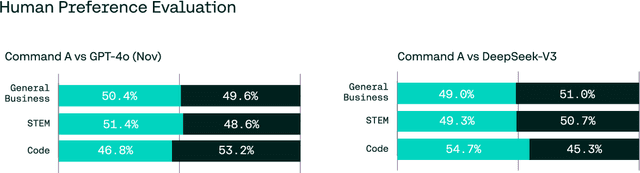
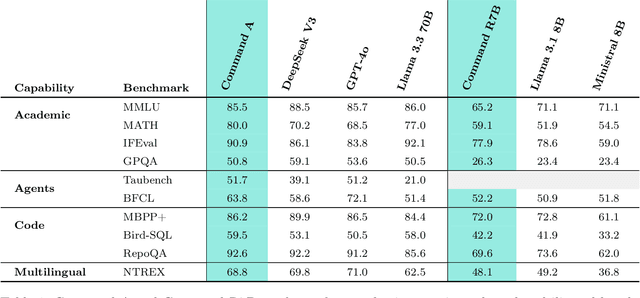
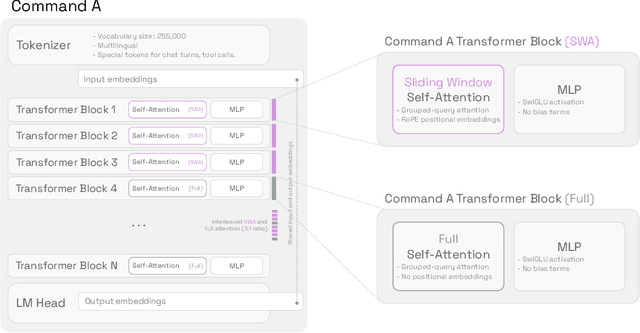
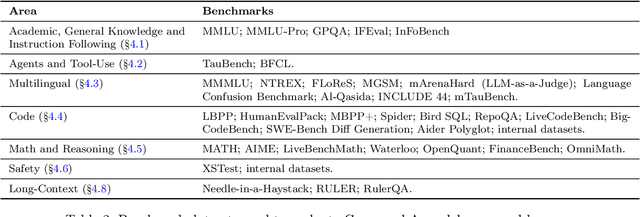
In this report we describe the development of Command A, a powerful large language model purpose-built to excel at real-world enterprise use cases. Command A is an agent-optimised and multilingual-capable model, with support for 23 languages of global business, and a novel hybrid architecture balancing efficiency with top of the range performance. It offers best-in-class Retrieval Augmented Generation (RAG) capabilities with grounding and tool use to automate sophisticated business processes. These abilities are achieved through a decentralised training approach, including self-refinement algorithms and model merging techniques. We also include results for Command R7B which shares capability and architectural similarities to Command A. Weights for both models have been released for research purposes. This technical report details our original training pipeline and presents an extensive evaluation of our models across a suite of enterprise-relevant tasks and public benchmarks, demonstrating excellent performance and efficiency.